Vertical integration in the poultry industry
In an earlier lesson in this series we traced a chicken's journey from an egg on a breeder farm to a chilled product on your table. But an important question remains: who runs that long journey and keeps it moving smoothly from one link to the next? In most of the modern poultry industry the answer is a model called vertical integration. This lesson explains what vertical integration is, why the industry moved to it, and how it directly shapes the quality, safety and price of the chicken you buy.
What is vertical integration?#
Vertical integration simply means that a single company owns or runs several successive stages of the production chain, instead of each stage being a separate business. In the integrated poultry model, one ownership ties all the links together: the feed mill, breeder farms, hatcheries, grow-out farms, the slaughter and processing plant, and the chilling and distribution network. According to the U.S. National Chicken Council, in the early days of the broiler business these stages were entirely separate businesses — independent feed mills, hatcheries, farms and processors, each selling into its own market — until, in the 1940s, firms known as integrators began combining them under one management to cut costs by coordinating the capacity of each stage with the next.
The links integration unites#
In practice, integration means gathering these links under one roof, each one feeding the next:
- Feed: an in-house feed mill that secures the quality and consistency of the birds' nutrition at every stage.
- Breeder farms and hatcheries: producing fertile eggs and hatching them into day-old chicks of a known specification.
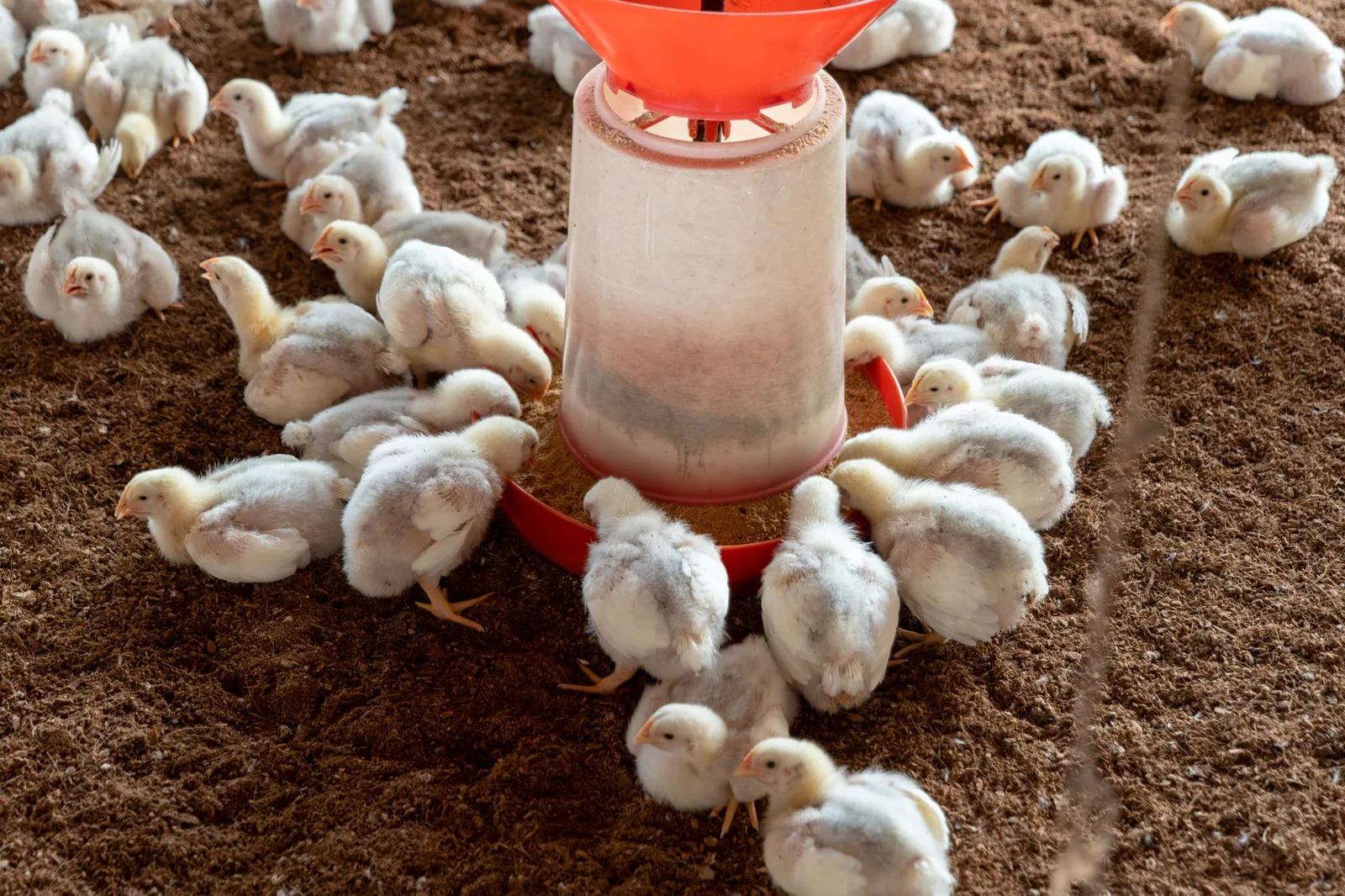
- Grow-out farms: raising the chicks to market weight under unified veterinary oversight.
- Processing: halal slaughter, cleaning, inspection, portioning and packing.
- Cold chain and distribution: chilled transport to distribution centres, shops and restaurants without breaking the cold chain.
Why the industry moved to this model#
The shift was not an accident; combining the stages under one management achieves an efficiency that is hard to reach when every link stands alone. The U.S. National Chicken Council notes that vertical integration has reduced the labour hours needed to produce each chicken, cut the amount of feed required per unit of meat thanks to advances in genetics and nutrition, and shortened the growing period needed to reach market weight — meaning less space, labour and equipment and a smaller environmental footprint — alongside better health programmes for bird welfare, and a tender, consistent product available at a reasonable price year-round.
How integration raises chicken quality and safety#
The biggest benefit for the consumer and the restaurant is not cost alone, but control over quality and safety across the whole chain. When one party owns every link, it can enforce the same standards from the breeder farm to the plant door. The National Chicken Council explains that this model gives greater governance over every aspect of food safety from the breeder farm, through the hatchery, to the processing plant: strict biosecurity, vaccination programmes, testing for bacteria such as Salmonella at breeder farms and hatcheries, heat-treating feed at the mill to stop germs passing to the birds, the all-in-all-out principle at grow-out farms to limit disease spread between flocks, and rigorous testing regimes inside the plant.
The most important practical effect is traceability: because one party keeps the records for every stage — test results, vaccination schedules, biosecurity and sanitation protocols — any problem can be traced quickly to its source and contained before it spreads. That is what makes recalls faster and more precise in integrated operations, and gives the restaurant and the consumer greater confidence in where the product came from.
Two models: full ownership and contract growing#
Vertical integration does not always mean the company owns every farm itself. In the United States, for example, more than ninety percent of chickens are raised by independent farmers working under contract with integrated companies, according to the National Chicken Council citing U.S. Department of Agriculture data: the farmer provides the land, housing and labour, while the company provides the chicks, feed, veterinary services, oversight and bird transport. This gives the farmer a guaranteed market and a steadier income, and gives the company control over quality and quantity. In Saudi Arabia, the large companies tend to run the chain through broader direct ownership, but the principle is the same: one management ties production together from feed to distribution.
Vertical integration in the Saudi poultry industry#
Most chicken production in Saudi Arabia is concentrated in a limited number of large national companies that operate a vertical-integration model; industry analyses indicate that around ten integrated firms lead the sector. This model is a cornerstone of the drive to raise poultry self-sufficiency that we covered in the sector-overview lesson, because integrated local production shortens the distance between plant and plate — and with it the cold chain — and keeps halal requirements disciplined across the whole chain under single oversight. In short, the more integrated and local the producer, the fresher, safer and more reliably sourced the chicken.
What this means for you when you buy#
Whether you are a restaurant owner or a consumer, vertical integration translates into tangible benefits: a consistent specification in every delivery, a documented cold chain, a source you can trace, and the ability to meet regular volumes year-round. When evaluating a supplier, ask how integrated its operations are: does it run production from feed to distribution? Can it trace a product back to its farm and production batch? Does it document transport temperatures? The answers reveal the difference between a supplier that sells a box and one with a whole chain standing behind that box.
Vertical integration, then, is not a distant economic term; it is what makes modern chicken available with consistent quality, a reasonable price and traceable safety. Across the rest of this series we complete the picture with sustainability and bird welfare, and the sector's quality standards and accreditations.