
Signs of spoiled chicken: check with your senses, and know where they fail you
It's a question that comes up in almost every kitchen: is this chicken still good? The honest answer has two sides. On one hand, your senses are an excellent inspection tool that catches chicken which has begun to spoil before it reaches your pan. On the other hand, the most dangerous thing in raw chicken is something no eye can see and no nose can smell. This lesson teaches you both: how to read chicken by smell, colour and texture in ten seconds, and where your senses stop working — where the date, the temperature and proper cooking take over.
The distinction that changes everything: spoilage vs pathogens#
On the surface of chicken there are two completely different families of microbes. The first is spoilage bacteria, such as Pseudomonas, which break the meat down and produce the foul smell, the slimy film and the colour change. These bacteria warn you: they are what make spoiled chicken look and smell spoiled. The second family is pathogenic bacteria, such as Salmonella and Campylobacter, whose target is your gut rather than the meat. The problem is that a piece of chicken carrying Salmonella can look, smell and taste perfectly normal; according to the US Centers for Disease Control (CDC) and food-safety authorities, these organisms cannot be seen, smelled or tasted.
From this distinction comes the practical rule for the whole lesson: passing the "sniff test" means the chicken hasn't spoiled yet, but it never means it is free of pathogens. That is why a sensory check does not replace cooking to a safe temperature, and why you must never taste raw chicken to judge it. Checking with your senses protects you from spoilage; proper cooking is what protects you from the invisible pathogens.
Two rules that don't conflict: if any sign of spoilage appears, the chicken goes straight in the bin; and if no sign appears, that doesn't mean it's sterile, so always cook it until its internal temperature reaches 74°C (165°F).
Smell: the first and most honest warning#
Fresh raw chicken has almost no smell; at most you might catch a faint, neutral meaty odour. A sour smell, or one resembling rotten eggs, sulfur or ammonia, is an outright sign of spoilage that calls for discarding the chicken immediately. Watch out for a common trap with vacuum-sealed or modified-atmosphere packs: they can release a confined odour the moment you open them that fades after a minute or two in the air. The correct judgement is made on the smell after the chicken has aired, not on the first breath at opening.
Colour: from natural pink to gray and green#
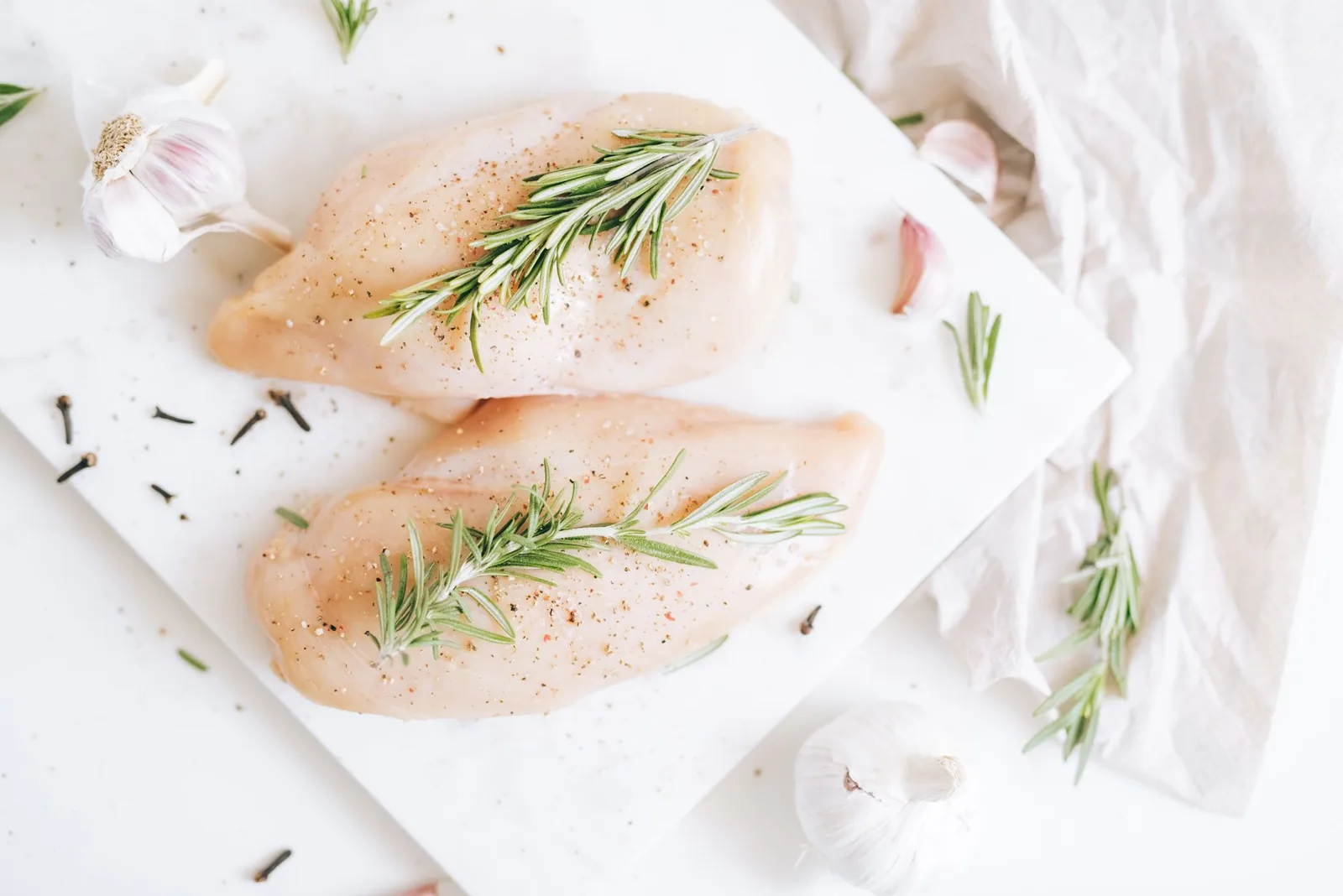
Fresh chicken flesh is pink, and its skin ranges from creamy white to yellow — this variation in skin colour is normal and comes down to the bird's feed and breed rather than spoilage, per the US Food Safety and Inspection Service (USDA/FSIS) guidance on the colour of meat and poultry. The warning colours are: a dull graying of the flesh, a green or blue tinge appearing, dark or green spots, or yellowing fat accompanied by an off smell. But colour on its own can mislead: a slight surface darkening from oxidation isn't necessarily spoilage. That's why colour is always read together with smell and texture, never in isolation.
- Normal: pink flesh, creamy-white to yellow skin, a faint sheen when moist.
- Questionable: slight surface darkening with no smell or slime — weigh it with the other signs.
- Spoiled: dull gray or greenish flesh, dark or green spots, especially alongside an off smell or texture.
Texture: sliminess is a decisive sign#
Fresh chicken is moist but not slippery, and it shouldn't stick to your fingers. A slimy, tacky or mucous film on the surface is clear bacterial growth (a biofilm) that calls for discarding the chicken, especially if it comes with an off smell. Watch the texture too: fresh meat is firm and springs back when pressed lightly, whereas soft meat that stays dented and doesn't bounce back is a further sign of deterioration.
Don't try to "rescue" slimy chicken by washing it. Washing raw chicken doesn't remove bacteria — it spreads them across your sink and surfaces, as we detailed in the cross-contamination lesson. When you find sliminess, the decision is to discard, not to wash.
Frozen chicken: freezer burn and signs of thaw-and-refreeze#
With frozen chicken there are two different problems that many people confuse. The first is freezer burn: grayish-brown, dry, leathery patches caused by air reaching the surface of the chicken. According to USDA/FSIS, freezer burn does not make chicken unsafe — it only makes it dry and tasteless in those spots; you can trim the affected patches and keep the rest, and you'd discard the whole piece only if the burn is severe, because its quality will have suffered. The second problem is the signs that chicken thawed and was refrozen: large ice crystals, frozen liquid pooled at the bottom of the pack, pieces fused into a single block, or a soft, bendable pack instead of a rock-solid one. These point to a broken cold chain, and they undermine the product's safety, not just its quality.
Freezing itself is an excellent preserver: at −18°C chicken stays safe for very long periods, but its quality declines after about twelve months for a whole bird and nine months for parts, per USDA. We covered storage periods in detail in the lesson on storing chicken correctly at home.
Why cooking doesn't rescue spoiled chicken#
You might think that thorough cooking solves everything, but that's true for pathogens, not for spoilage. The high heat that brings the meat to 74°C kills live bacteria, yet it does not undo spoilage: a spoiled surface already carries an enormous bacterial load, some bacteria will have released heat-stable byproducts and toxins that cooking can't be relied on to destroy, and the off taste and smell remain. Proper cooking, then, is meant for the invisible pathogens on fresh chicken — not a way to rescue chicken that has begun to spoil.
The USDA's golden rule when unsure: "When in doubt, throw it out." The price of one wasted chicken breast is nothing next to a bout of food poisoning that wrecks your day or lands you in hospital.
Prevention: stop spoilage before it starts#
- Make chicken the last thing into your cart, move it to the fridge the moment you get home, and keep it at 4°C or below.
- Raw chicken keeps in the fridge for one to two days and cooked chicken for three to four, per SFDA and USDA; freeze it if you won't use it in time.
- Don't leave chicken more than two hours at room temperature, or one hour if it's above 32°C — the danger zone runs between 4°C and 60°C.
- Keep raw chicken tightly sealed on the bottom shelf of the fridge so it can't drip onto anything.
- Never refreeze chicken that thawed outside the fridge.
- Read the label date, but remember it's a promise conditional on the cold chain staying intact.
The 10-second check, summarized#
- Smell: once it airs, is it sour, sulfurous or ammonia-like? Discard it.
- Colour: dull gray, a green tinge, or dark spots with an off smell? Discard it.
- Texture: a slimy or tacky film, or soft meat that won't spring back? Discard it.
- Date and temperature: past the date, or the cold chain broke? Discard it.
- Passed all of the above? Fine to cook — and always cook it to 74°C.